
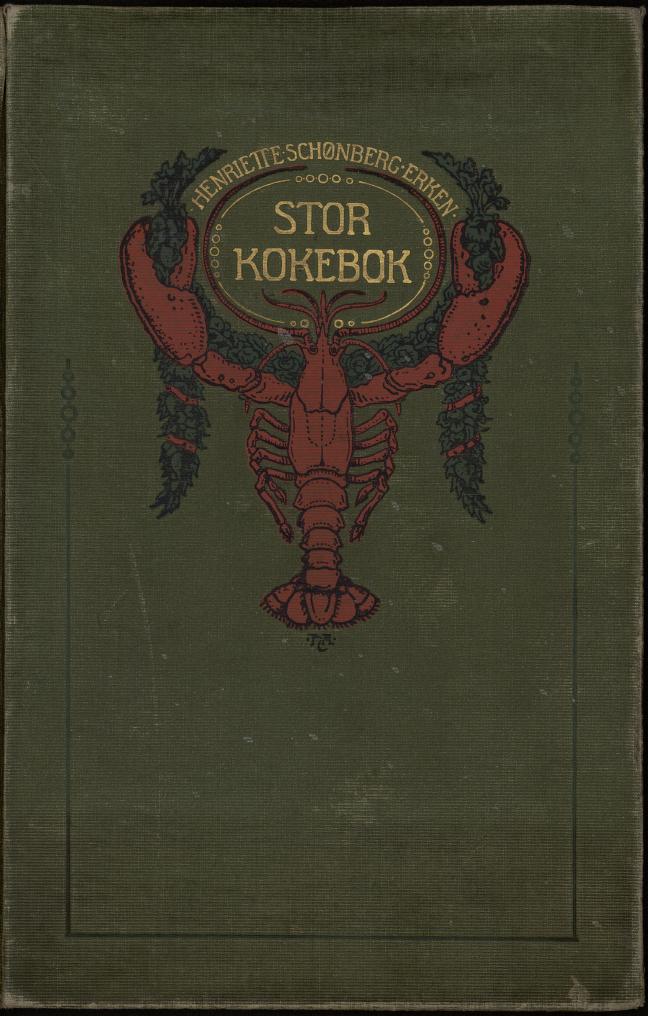
Stor kokebok (for større om mindre husholdninger osv.)
The book's full title is Stor kokebok for større og mindre husholdninger. Kokning, bakning, syltning, vinlægning, slagtning, hermetik, sykekost, menuer, anretning. In 1914, the first edition of what is commonly known as Stor kokebok was published, one of the most discussed cookbooks in this country. The 20th ordinary edition of the book appeared in 1951; since then, three facsimile editions (exact copies) have been issued, in 1980, 1996 and 2002. The first two are copies of the first edition, the last of the 1951 version. Before the last of these "reprises" reached the shops, Stor kokebok had sold a staggering 213,000 copies over the years. Both the first and second editions featured the so-called "lobster cover", designed by Halfdan Arneberg. A few years ago, a second-hand bookshop in Oslo sold a copy of the first edition for 8,000 kroner, but you can get it cheaper. It depends somewhat on the amount of sauce stains and other …
The book's full title is Stor kokebok for større og mindre husholdninger. Kokning, bakning, syltning, vinlægning, slagtning, hermetik, sykekost, menuer, anretning. In 1914, the first edition of what is commonly known as Stor kokebok was published, one of the most discussed cookbooks in this country. The 20th ordinary edition of the book appeared in 1951; since then, three facsimile editions (exact copies) have been issued, in 1980, 1996 and 2002. The first two are copies of the first edition, the last of the 1951 version. Before the last of these "reprises" reached the shops, Stor kokebok had sold a staggering 213,000 copies over the years. Both the first and second editions featured the so-called "lobster cover", designed by Halfdan Arneberg. A few years ago, a second-hand bookshop in Oslo sold a copy of the first edition for 8,000 kroner, but you can get it cheaper. It depends somewhat on the amount of sauce stains and other wear, but the edition also exists with other forms of private binding. In the preface, Henriette Schønberg Erken writes that "The extensive material in this book is due partly to my own experience and a long series of constant experiments and observations, partly to the study of the most modern foreign works". The book has 708 pages and is extremely rich in content. The ingredients range from eel to lobster, from pork chops to turtle soup: "The turtle should be fat and as fresh as possible – still alive. When it is to be slaughtered, it is either placed on its back on a sloping board, or hung by its hind legs. In both cases, a noose is placed around its neck when it sticks its head out. The head is pulled out as far as possible and cut off". Stor kokebok contains no fewer than five recipes for (real and fake) turtle soup, but this was hardly everyday Norwegian food at the time. Today, the book has greater historical and cultural value than it is useful as a cookbook. Arne Brimi has said in an interview with Dagbladet that "I sometimes use it to see how things were", while Ingrid Espelid Hovig tells us that "it has probably not inspired me very much during the work on my own books and programmes, but I have often used it as a point of comparison". "A treasure I respect", says Bent Stiansen to the same newspaper.
In the chapter "Litt sykepleie og sykemat", the author gives the following advice: "Never ask the sick person what they want to eat; think for yourself what is best". And the best could be oatmeal water, eggedram (egg yolk, icing sugar and cold, strong coffee), water (boiled water whisked with a fork), fried goat kids and omelette with spinach.
– Per